spanduk
Beranda

Peralatan Uji Suhu

Peralatan Uji Suhu

  • Small Rapid Temperature Change (Wet Heat) Test Chamber
    Nov 01, 2025
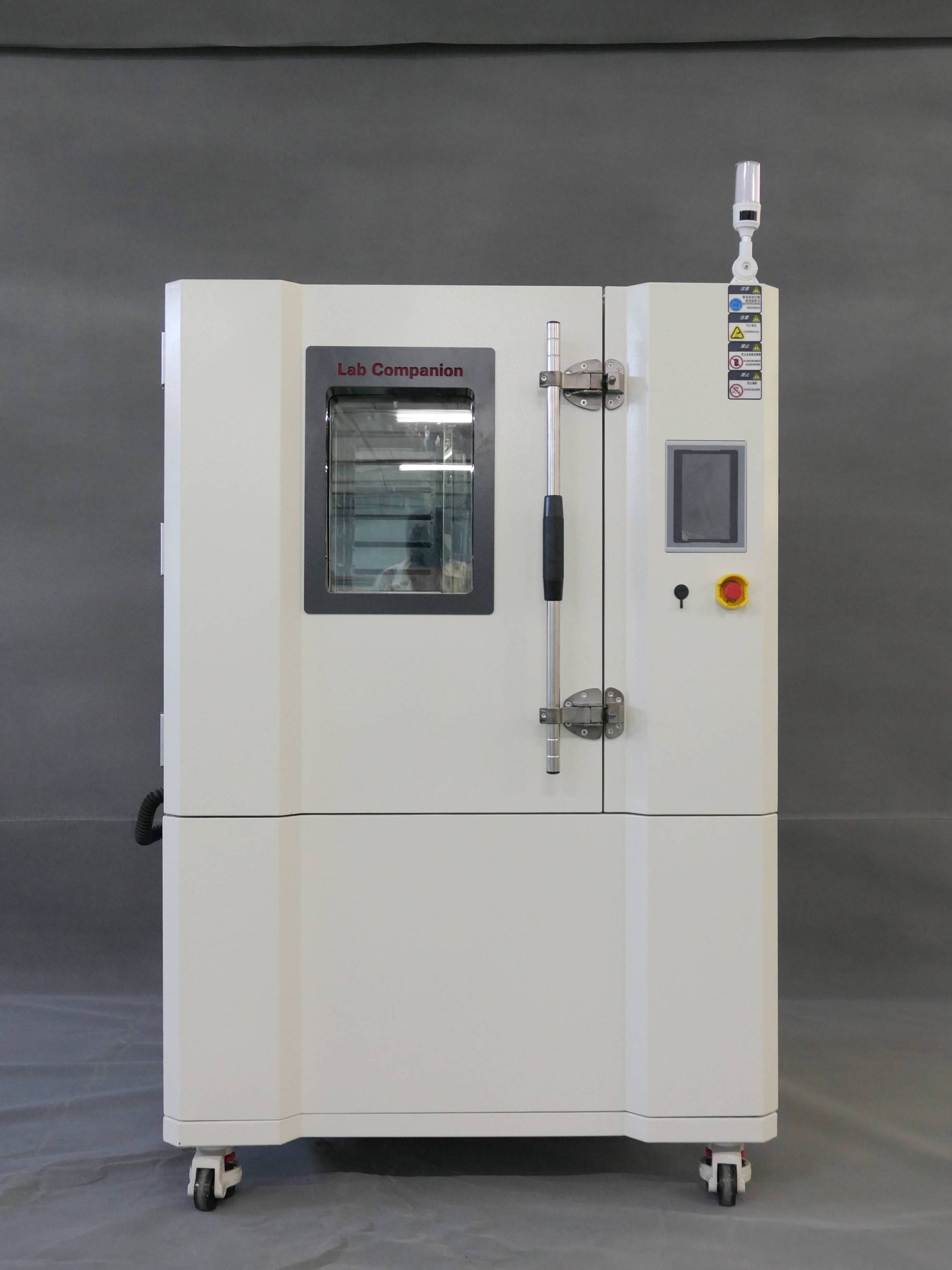
    In response to the testing and R&D requirements of electronic components such as semiconductors and automotive electronics, Lab Companion has developed a smaller capacity small rapid temperature change (wet heat) test chamber. While maintaining the advantages of standard rapid temperature change test chambers, it can also meet the needs of customers who have requirements for space size, with a single-phase 220VAC voltage specification. It can also meet the equipment usage requirements of customers in civilian office areas such as research institutions and universities. Its main features are as follows: 1. It has powerful heating and cooling performance 2. Heating rate: 15℃/min; Cooling rate: 15℃/min 3. (Temperature range: -45℃ to +155℃) 4. Single-phase 220VAC, meeting the electricity demands of more customers 5. Single-phase 220VAC, suitable for industrial and civil power supply specifications, can meet the equipment power demands of customers in civil office areas such as research institutions and universities. 6. The body is small and exquisite, with a compact structure and easy to move 7. The miniaturized structure design of the test chamber can effectively save configuration space. 8. The inner tank volume is 100L, the width is 600mm, the depth is less than 1400mm, and the product volume is less than 1.1m ³. It is suitable for the vast majority of residential and commercial elevators in China (GB/T7025.1). 9. The standard universal wheels enable the product to move freely at the installation site. 10. Standard air-cooled specification is provided, facilitating the movement and installation of the product 11. At the same time, it saves customers the cost and space of configuring cooling towers. 12. A more ergonomic operation touch screen design 13. Through the multi-angle adjustment of the touch screen, it can meet the operation needs and provide the best field of vision for users of different heights, making it more convenient and comfortable. 14. Energy-saving cold output temperature and humidity control system, with dual PID and water vapor partial pressure control, features mature technology and extremely high precision. 15. Network control and data acquisition can be carried out through the interface (RS-485/GPIB/Web Lan/RS-232C). 16. It is standard-equipped with left and right cable holes (50mm), which facilitates the connection of power on the sample and the conduct of multiple measurements. 17. The controller adopts a color LCD touch screen, which is simple and convenient to operate 18. Through the controller, two control methods, fixed value and program, can be selected to adapt to different applications. 19. The program control can be set to 100 modes, with 99 steps for each mode. Repeat the loop up to 999 times. 20. Multiple languages can be easily switched (Simplified Chinese, English), and test data can be stored on a USB flash drive.
    BACA SELENGKAPNYA
  • Flame-retardant PP Materials in Industry Working Principle
    Oct 27, 2025
    Polypropylene (PP) itself is a highly flammable hydrocarbon with a limiting oxygen index (LOI) of only 17.8%. It will continue to burn even after being removed from the fire source. The core principle of flame-retardant PP is to interrupt or delay its combustion cycle through physical and chemical means. Combustion requires the simultaneous existence of three elements: combustible material, heat and oxygen. The function of flame retardants is to destroy this "burning triangle".   In industry, flame retardancy is mainly achieved by adding flame retardants to PP. Different types of flame retardants function through the following mechanisms: 1. Gas-phase flame retardant mechanism This is one of the most common mechanisms, especially applicable to traditional halogen-based flame retardants. When flame retardants are heated and decomposed, they can capture the free radicals (such as H· and HO·) that maintain the combustion chain reaction in the combustion reaction zone (flame), causing their concentrations to drop sharply and thus interrupting the combustion. 2. Condensed phase flame retardant mechanism This is the most mainstream mechanism of halogen-free flame-retardant PP. Flame retardants promote the formation of a uniform and dense carbon layer on the surface of polymers. This layer of carbon has three major functions. The first step is to prevent external heat from entering the interior of the polymer. Secondly, it prevents the escape of flammable gases inside and the entry of external oxygen. Finally, it inhibits the further pyrolysis of the polymer and the generation of smoke. When a fire occurs, the acid source promotes the dehydration, cross-linking and carbonization of the carbon source. Meanwhile, the large amount of gas produced by the decomposition of the gas source causes the softened carbon layer to expand, eventually forming a porous, dense and strong foam carbon layer, which protects the underlying PP like "armor". 3. Cooling/heat absorption mechanism Flame retardants absorb a large amount of heat during the decomposition process, reducing the surface temperature of polymers and making it difficult for them to continuously pyrolyze and produce flammable gases. Typical representatives include aluminium hydroxide (ATH) and magnesium hydroxide (MH). When they decompose, they absorb a large amount of heat (endothermic reaction) and release water vapor. The water vapor can not only dilute flammable gases but also play a cooling role. 4. Dilution mechanism Flame retardants decompose to produce a large amount of non-flammable gases (such as water vapor and CO₂, etc.), which can dilute the concentration of flammable gases and oxygen near the polymer surface, making combustion unsustainable. Both the gas sources of metal hydroxides and intumescent flame retardants have this function.   In conclusion, the working principle of flame-retardant PP in industry is a complex process involving the synergy of multiple mechanisms. Modern flame-retardant PP technology is developing towards halogen-free, low smoke, low toxicity and high efficiency. Among them, the condensed phase flame-retardant mechanism represented by intumescent flame retardants (IFR) is the core of current research and application. By carefully designing flame-retardant formulas, the best balance can be achieved among flame-retardant efficiency, material mechanical properties, processing performance and cost.
    BACA SELENGKAPNYA

  • How is over-temperature protection carried out in a temperature test chamber?
    Oct 23, 2025
    The over-temperature protection of the temperature test chamber is a multi-level and multi-redundant safety system. Its core purpose is to prevent the temperature inside the chamber from rising out of control due to equipment failure, thereby protecting the safety of the test samples, the test chamber itself and the laboratory environment.   The protection system usually consists of the following key parts working together: 1. Sensor: The main sensor is used for the normal temperature control of the test chamber and provides feedback signals to the main controller. An independent over-temperature protection sensor is the key to a safety system. It is a temperature-sensing element independent of the main control temperature system (usually a platinum resistance or thermocouple), which is placed by strategically at the position within the box that best represents the risk of overheating (such as near the heater outlet or on the top of the working chamber). Its sole task is to monitor over-temperature. 2. Processing unit: The main controller receives signals from the main sensor and executes the set temperature program. The independent over-temperature protector, as an independent hardware device, is specifically designed to receive and process the signals from the over-temperature protection sensor. It does not rely on the main controller. Even if the main controller crashes or experiences a serious malfunction, it can still operate normally. 3. Actuator: The main controller controls the on and off of the heater and the cooler. The safety relay/solid-state relay receives the signal sent by the over-temperature protector and directly cuts off the power supply circuit of the heater. This is the final execution action.   The over-temperature protection of the temperature test chamber is a multi-level, hard-wire connected safety system designed based on the concepts of "redundancy" and "independence". It does not rely on the main control system. Through independent sensors and controllers, when a dangerous temperature is detected, it directly and forcibly cuts off the heating energy and notifies the user through sound and light alarms, thus forming a complete and reliable safety closed loop.
    BACA SELENGKAPNYA
  • Prinsip Penyeimbangan Suhu di Dalam Ruang Uji dengan Katup Udara
    Sep 22, 2025
    Prinsip intinya adalah sistem umpan balik negatif loop tertutup "pemanasan - pengukuran - kontrol". Sederhananya, sistem ini mengontrol daya elemen pemanas di dalam kotak secara presisi untuk menangkal pembuangan panas yang disebabkan oleh lingkungan eksternal, sehingga mempertahankan suhu uji konstan yang lebih tinggi daripada suhu sekitar. Proses stabilisasi suhu oleh katup udara merupakan loop tertutup yang dinamis dan terus-menerus menyesuaikan: Pertama, tetapkan suhu target. Sensor suhu akan mengukur suhu aktual di dalam kotak secara real-time dan mengirimkan sinyal ke pengontrol PID.Ketika pengontrol PID menghitung nilai kesalahan, ia menghitung daya pemanas yang perlu disesuaikan berdasarkan nilai kesalahan tersebut melalui algoritma PID. Algoritma ini akan mempertimbangkan tiga faktor:P (proporsi): Seberapa besar kesalahan arus? Semakin besar kesalahannya, semakin besar pula rentang penyesuaian daya pemanas.I (integral): Akumulasi kesalahan selama periode waktu tertentu. Ini digunakan untuk menghilangkan kesalahan statis (misalnya, jika selalu terdapat sedikit deviasi, suku integrasi akan secara bertahap meningkatkan daya untuk menghilangkannya sepenuhnya).D (diferensial): Laju perubahan kesalahan arus. Jika suhu mendekati target dengan cepat, daya pemanas akan dikurangi terlebih dahulu untuk mencegah "overshoot".3. Pengontrol PID mengirimkan sinyal terhitung ke pengontrol daya elemen pemanas (seperti relai solid-state SSR), yang secara tepat mengatur tegangan atau arus yang diterapkan ke kawat pemanas, sehingga mengendalikan pembangkitan panasnya.4. Kipas sirkulasi bekerja terus menerus untuk memastikan panas yang dihasilkan oleh pemanasan terdistribusi dengan cepat dan merata. Pada saat yang sama, kipas ini juga dengan cepat mengirimkan kembali perubahan sinyal dari sensor suhu ke pengontrol, sehingga respons sistem lebih cepat. Penyeimbang katup udara mengukur volume udara, sementara densitas udara bervariasi seiring suhu. Pada nilai tekanan diferensial yang sama, laju aliran massa atau laju aliran volume udara dengan densitas berbeda akan berbeda pula. Oleh karena itu, suhu harus distabilkan pada nilai tetap yang telah diketahui agar mikroprosesor di dalam instrumen dapat menghitung nilai volume udara secara akurat dalam kondisi standar berdasarkan nilai tekanan diferensial yang terukur menggunakan rumus yang telah ditentukan sebelumnya. Jika suhu tidak stabil, hasil pengukuran tidak akan dapat diandalkan.
    BACA SELENGKAPNYA
  • Prinsip Kerja Lab Companion Pendingin Kompresi Mekanis Berpendingin Udara Prinsip Kerja Lab Companion Pendingin Kompresi Mekanis Berpendingin Udara
    Sep 06, 2025
    1.KompresiRefrigeran gas bersuhu dan bertekanan rendah mengalir keluar dari evaporator dan dihisap oleh kompresor. Kompresor bekerja pada bagian gas ini (menggunakan energi listrik) dan mengompresnya dengan kuat. Ketika refrigeran berubah menjadi uap super panas bersuhu dan bertekanan tinggi, suhu uap tersebut jauh lebih tinggi daripada suhu sekitar, sehingga menciptakan kondisi yang memungkinkan pelepasan panas ke luar.2. KondensasiUap refrigeran bersuhu dan bertekanan tinggi memasuki kondensor (biasanya berupa penukar kalor tabung bersirip yang terdiri dari tabung tembaga dan sirip aluminium). Kipas mendorong udara sekitar untuk berhembus melewati sirip-sirip kondensor. Selanjutnya, uap refrigeran melepaskan panas ke udara yang mengalir di dalam kondensor. Karena pendinginan, uap tersebut secara bertahap mengembun dari wujud gas menjadi cairan bersuhu sedang dan bertekanan tinggi. Pada titik ini, panas dipindahkan dari sistem refrigerasi ke lingkungan luar.3. EkspansiRefrigeran cair bersuhu sedang dan bertekanan tinggi mengalir melalui saluran sempit melalui perangkat pelambatan, yang berfungsi untuk membatasi dan mengurangi tekanan, mirip dengan menutup lubang pipa air dengan jari. Ketika tekanan refrigeran turun tiba-tiba, suhunya juga turun tajam, berubah menjadi campuran dua fase gas-cair bersuhu rendah dan bertekanan rendah (kabut).4. PenguapanCampuran gas-cair bersuhu rendah dan bertekanan rendah memasuki evaporator, dan kipas lain mengalirkan udara di dalam kotak melalui sirip-sirip evaporator yang dingin. Cairan refrigeran menyerap panas udara yang mengalir melalui sirip-sirip evaporator, menguap dan berevaporasi dengan cepat, lalu kembali menjadi gas bersuhu rendah dan bertekanan rendah. Akibat penyerapan panas ini, suhu udara yang mengalir melalui evaporator turun secara signifikan, sehingga tercapai pendinginan ruang uji. Selanjutnya, gas bersuhu dan bertekanan rendah ini kembali ditarik ke dalam kompresor, memulai siklus berikutnya. Dengan cara ini, siklus tersebut berulang tanpa henti. Sistem refrigerasi terus-menerus "memindahkan" panas di dalam kotak ke luar dan membuang panas tersebut ke atmosfer melalui kipas.
    BACA SELENGKAPNYA

Tinggalkan pesan

Tinggalkan pesan
Jika Anda tertarik dengan produk kami dan ingin mengetahui lebih detail, silakan tinggalkan pesan di sini, kami akan membalas Anda sesegera mungkin.
kirim

Beranda

Produk

Ada apa

Hubungi kami